
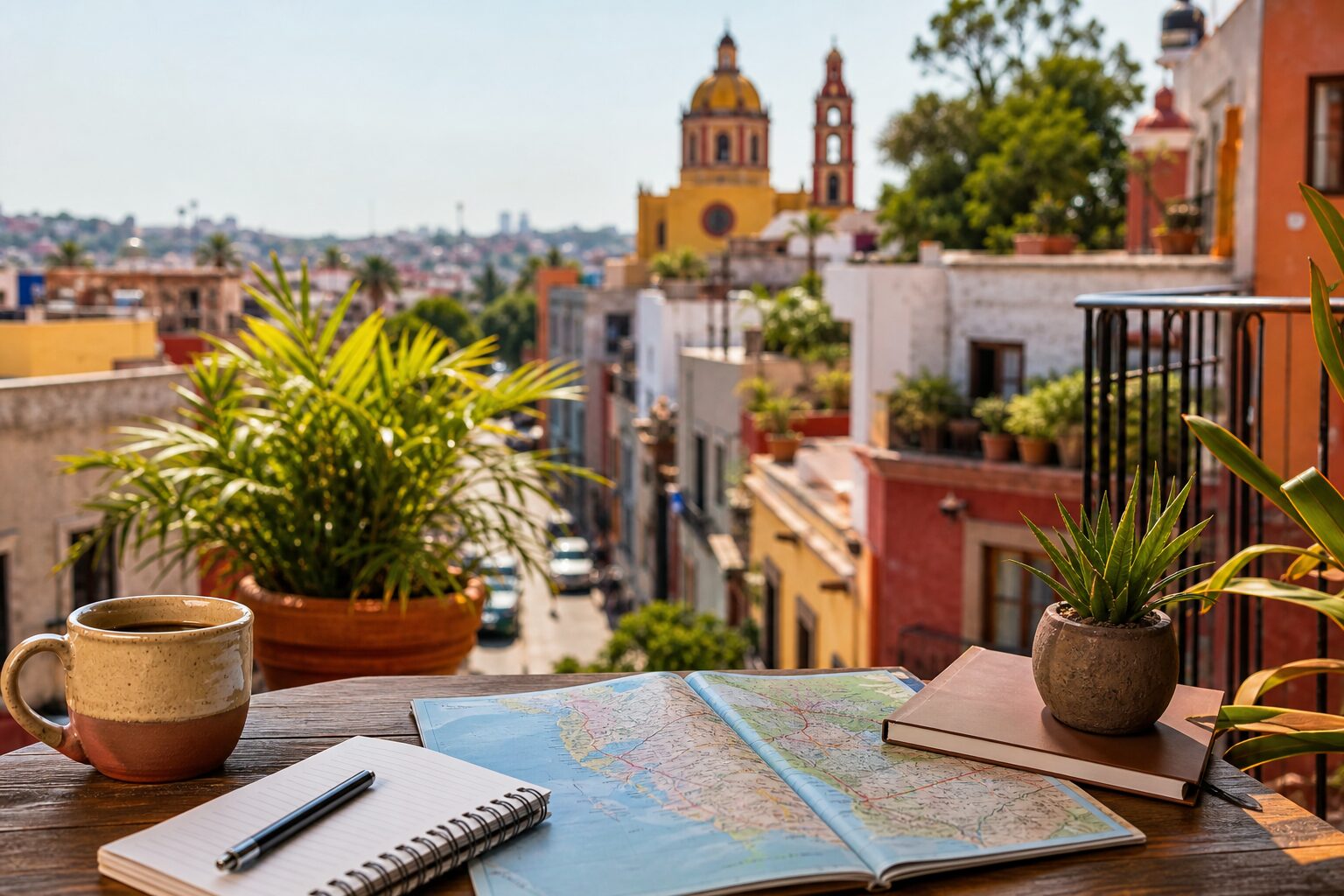
Thinking about moving to Mexico? For many Americans, Mexico feels like one of the most realistic countries to research first. It is close to the United States, flights can be manageable, the culture is rich, the food is world-famous, and there are already established communities of Americans, retirees, remote workers, and long-term visitors in many parts of the country.
But Mexico is not one simple lifestyle. Mexico City, Merida, San Miguel de Allende, Puerto Vallarta, Guadalajara, Oaxaca, Queretaro, Lake Chapala, Baja California, and beach towns along both coasts can feel very different from each other. Cost of living, climate, healthcare, safety, transportation, language needs, and daily routines vary by region and neighborhood.
This starter guide is designed to help you think through the basics before going deep on visas, residency, taxes, healthcare, housing, safety, logistics, and long-term planning.
If you are still organizing the overall process, start with the How to Move Abroad guide before narrowing your destination research.
Quick take: who Mexico may fit
Mexico may be worth researching if you want:
- A country close to the United States
- A lower-friction first move abroad compared with farther destinations
- A mix of large cities, colonial towns, beaches, mountains, and smaller communities
- A place with established expat and retiree communities in some areas
- Easier family visits back to the United States than many overseas options
- A country where cost, climate, and lifestyle can vary widely by region
Mexico may be a weaker fit if you need:
- A move with no paperwork or residency planning
- A country where you can ignore Spanish completely
- A guaranteed low-cost lifestyle in the most popular areas
- A simple employer-approved remote-work setup
- A place where safety questions can be treated casually
- A destination that feels the same across every city, state, or neighborhood
At a Glance
| Factor | Assessment |
|---|---|
| Cost of living | Highly variable, with popular expat and tourist areas often much more expensive than smaller cities |
| Ease for Americans | Moderate to strong for proximity, but residency, safety, and local logistics still need careful research |
| Language barrier | Moderate, lower in expat-heavy areas and higher in local admin, healthcare, and daily errands |
| Healthcare access | Strong in major cities and established expat hubs, more mixed by region |
| Climate variety | Substantial, with coasts, highlands, desert, mountains, and humid tropical areas |
| Remote-work practicality | Strong for U.S. time zones, but employer approval, taxes, and visa fit still matter |
| Family appeal | Mixed, depending on safety, schooling, language, healthcare, and neighborhood fit |
| Retirement appeal | Strong in established areas, with region-specific planning required |
| Distance from the United States | Close, with easier family visits than most overseas options |
| Main tradeoff | Major regional differences in safety, infrastructure, transportation, healthcare, and daily comfort |
Why Mexico is popular with people considering life abroad
Mexico has a strong pull for Americans because it can feel both adventurous and practical. It is international, but not across an ocean. It can offer a very different daily rhythm, but flights back to the United States may still be realistic. Some people are drawn to Mexico City for culture and energy. Others look at Merida, San Miguel de Allende, Lake Chapala, Puerto Vallarta, Oaxaca, Baja California, or smaller towns for lifestyle, weather, community, or affordability.
That variety is part of the appeal, but it is also the main planning trap. “Moving to Mexico” is too broad to be a real plan. Living in a dense Mexico City neighborhood is not the same as living near Lake Chapala. A beach town is not the same as a highland city. A border community is not the same as Oaxaca or Merida.
A good first step is not asking whether Mexico is the best country to move to. It is asking which version of Mexico could actually fit your budget, work situation, healthcare needs, Spanish level, safety expectations, and daily routines.
Remote work and income questions
Mexico may seem especially attractive to remote workers because of its proximity to the United States and time-zone compatibility. For some U.S.-based workers, Mexico may be easier than Europe or Australia from a meeting-schedule standpoint.
But remote work from Mexico is not just a laptop-and-Wi-Fi decision. You still need to think about immigration status, employer approval, payroll, tax residency, benefits, data security, client contracts, and whether your work setup is allowed under the status you hold.
If you plan to work remotely from Mexico for a U.S. employer, ask:
- Does my employer allow work from Mexico?
- Would my role create payroll, tax, security, privacy, benefits, or compliance issues?
- Would my company allow access to systems from Mexico?
- Am I visiting temporarily, testing a lifestyle, or planning residency?
- Would my work setup create Mexican tax or registration questions?
- Could I maintain U.S. work hours from the city I am considering?
- What would happen if my employer changed its remote-work policy?
If you are still pressure-testing the work side, read Can I Really Work Remotely From Another Country? before you commit emotionally to the idea.
Visa and residency reality check
For Americans, visiting Mexico is not the same thing as moving there. The U.S. State Department’s Mexico entry and exit procedures explain that travelers entering by air need a passport book and that Mexican authorities issue digital Forma Migratoria Multiple documents at international airports. By land, travelers need a passport book or card and must apply for an FMM entry permit online or from an INM office.
The Mexican Embassy know before you go guidance is also a useful reminder that entry rules, tourism expectations, and travel prep should be checked before you book a scouting trip or longer stay.
Mexico’s Forma Migratoria Multiple is tied to visitor status without permission to work. That matters because being allowed to enter as a visitor is not the same thing as having long-term residence or work permission.
If you want to stay longer, establish a base, or make Mexico part of a long-term plan, you may need to research temporary or permanent residence. Mexican consular pages describe a temporary resident visa as a pathway for people who intend to stay in Mexico for more than 180 days and less than four years, depending on the category and requirements.
Another important detail: a visa issued by a Mexican consulate is usually not the final step. Mexican consular guidance on visas and migratory documents explains that holders of temporary or permanent resident visas must obtain the corresponding resident card after entering Mexico within the required timeframe.
The key MoveMap takeaway: Mexico can feel easy to reach, but residency still requires real paperwork. Do not assume that a visitor entry, a snowbird routine, or remote income automatically gives you long-term permission to live there.
That is also why The Visa Reality Check: Why You Can’t Pick a Country on Vibes Alone belongs in the same reading stack.
Cost of living: Mexico is not one budget
Mexico is often described as affordable, but that can be misleading without context. The real question is not “Is Mexico cheap?” The better question is “Would my actual life work in the specific place I am considering?”
Popular expat areas can be more expensive than people expect. Beach towns, historic city centers, high-demand neighborhoods, and areas with strong foreign demand can behave differently from smaller cities or less internationally visible areas. Your lifestyle, housing expectations, healthcare needs, transportation, and travel back to the United States all matter.
Build your comparison around your real life:
- Rent or mortgage expectations
- Neighborhood and city choice
- Utilities and internet
- Groceries and eating out
- Transportation and whether you need a car
- Health insurance or healthcare costs
- Flights or drives back to the United States
- Visa, residency, and document costs
- Taxes and professional advice
- Shipping, storage, pets, and household goods
- Emergency savings
- Currency changes and exchange-rate risk
Mexico may be more affordable than some parts of the United States for certain lifestyles, but it is not automatically cheap. A low-cost lifestyle in one city does not mean the same budget works in every desirable neighborhood.
A MoveMap-style comparison should start with your real monthly needs, not someone else’s “I live here for X” video.
Climate and daily comfort
Mexico’s climate varies dramatically by region, elevation, coast, and season. The Servicio Meteorologico Nacional provides official weather information for Mexico, which is useful because the country is too varied to summarize with one climate label.
Do not assume all of Mexico is hot beach weather. Mexico City has elevation and a different feel from Merida. San Miguel de Allende is different from Puerto Vallarta. Oaxaca is different from Baja California. Coastal humidity, inland dryness, rainy seasons, hurricane exposure, altitude, air quality, heat, and water concerns can all affect daily comfort.
Research questions to ask:
- Do I handle heat and humidity well?
- Would elevation affect me?
- Do I want beach weather, mountain weather, highland weather, or city weather?
- How important is air conditioning?
- Would rainy season affect my routines?
- Is the area affected by hurricanes, flooding, drought, or wildfire risk?
- How would climate affect walking, errands, work, sleep, and social life?
- Does the housing stock match my comfort needs?
Climate is not just weather. It affects mood, housing comfort, energy costs, transportation, routines, sleep, social life, and whether you actually live the life you imagined.
If you want a broader decision lens, read Climate, Comfort, and Daily Life: What People Forget Before Moving Abroad and compare Mexico with Moving to Spain: A Starter Country Guide for Americans.
Healthcare and insurance questions
Mexico is known for having both public and private healthcare options, but access and experience vary by status, location, budget, and medical needs. Do not assume that moving to Mexico automatically solves healthcare costs or coverage.
IMSS voluntary registration for foreigners explains that foreigners in Mexico can voluntarily register with Social Security as independent or self-employed persons so they and their legal beneficiaries can receive coverage, subject to the program’s rules and requirements. That is useful to know, but it does not mean every person or medical situation will fit that path.
Many Americans also research private healthcare and private insurance in Mexico, especially if they want English-speaking providers, faster specialist access, or care in areas popular with expats. Your options can depend heavily on the city, your age, existing conditions, prescriptions, budget, and whether you plan to maintain any U.S. coverage.
Questions to research:
- Would you use private healthcare, public healthcare, or both?
- Are you eligible for voluntary IMSS registration?
- Would private insurance cover your needs?
- Are your prescriptions available in Mexico?
- Would you need specialists?
- Is English-speaking care important to you?
- How close would you be to clinics, hospitals, and emergency care?
- What would you do for a serious medical event?
Healthcare planning matters even more if you have children, prescriptions, a chronic condition, mental health care needs, or a partner whose coverage depends on your residency or work situation.
Taxes and paperwork basics
Taxes can get complicated quickly when you move abroad, especially if you are American. The United States has its own tax filing rules for citizens abroad, and Mexico has its own tax registration and tax residency questions.
SAT registration for foreigners explains the process for foreigners who need to register in Mexico’s RFC as individuals when they will carry out economic activity. SAT tax residence certificate guidance describes a tax-residence-related service for people or entities with active RFC status and qualifying circumstances.
Do not treat tax residency as an afterthought. If you earn U.S. income, work for a U.S. employer, freelance, own a business, have investments, receive retirement income, rent out property, or relocate with a spouse, get professional advice before making assumptions.
Put these on your research list:
- Mexican tax residency
- U.S. tax filing obligations
- RFC registration if relevant
- CURP if relevant
- Foreign earned income and foreign tax credit questions
- Employer payroll and withholding concerns
- Self-employment or business registration issues
- Bank account setup
- Residency document requirements
- Tax advice in both countries
A move to Mexico can be practical, but taxes and paperwork need to be part of the early plan.
Safety and regional risk
Safety is one of the most important Mexico research topics, and it needs to be handled carefully. Mexico is not one risk profile. Safety conditions can vary by state, city, neighborhood, road, time of day, and activity.
The U.S. State Department Mexico Travel Advisory provides state-by-state guidance and identifies risks such as crime, kidnapping, and other safety concerns in certain areas. This does not mean every place in Mexico carries the same risk. It does mean you should research your exact destination, route, neighborhood, and daily routines with current official guidance and local information.
Safety questions to ask:
- What is the current advisory for the state I am researching?
- Are there city or neighborhood differences I need to understand?
- How will I get around during the day and at night?
- Will I drive, walk, use rideshare, use buses, or rely on taxis?
- Are there highways or regions I should avoid?
- How close am I to emergency care?
- What would I do in a medical, legal, or family emergency?
- How quickly could I return to the United States if needed?
Safety is not just crime. It is also transportation, emergency access, natural hazards, language barriers, medical care, and whether your daily routines match your risk tolerance.
Shipping, pets, and household logistics
Mexico can be logistically easier than farther destinations because of its proximity to the United States, but that does not mean you should skip planning. You still need to decide what to sell, store, ship, drive, or replace.
Pets may be simpler than in some countries, but you still need to check current rules. USDA APHIS pet travel to Mexico states that a health certificate for dogs and cats is no longer needed to enter Mexico from the United States, and that dogs and cats may be inspected by SENASICA upon arrival. You should still follow the current APHIS guidance and verify details before travel.
Before moving Mexico higher on your shortlist, research:
- What you would sell, store, ship, drive, or replace
- Whether you would bring a vehicle
- Temporary vehicle import rules if relevant
- Pet travel requirements
- Temporary housing after arrival
- School enrollment if relevant
- Driver’s license and transportation options
- Banking and phone setup
- Mail forwarding from the United States
- Spanish needed for leases, utilities, doctors, and bureaucracy
The logistics may be manageable, but they still matter. Mexico can feel familiar because it is close, but moving there is not the same thing as taking a vacation.
Best places in Mexico to research first
This guide is not ranking cities. The best place depends on your budget, Spanish level, healthcare needs, climate preferences, safety comfort, transportation style, family situation, and tolerance for tourism or big-city energy.
Mexico City
Mexico City may appeal if you want a major global city, culture, food, museums, public transit, parks, and international energy. The tradeoffs may include air quality, traffic, housing competition, altitude, and big-city complexity.
Merida
Merida may appeal if you want a calmer city, warm weather, Yucatan culture, and an established expat presence. The tradeoffs may include intense heat, humidity, and the need to understand neighborhood-by-neighborhood lifestyle differences.
San Miguel de Allende
San Miguel de Allende may appeal if you want a beautiful colonial city, arts, walkability, and a large expat community. The tradeoffs may include popularity, pricing pressure, and a lifestyle that may not feel representative of Mexico overall.
Lake Chapala and Ajijic
Lake Chapala and Ajijic may appeal if you want an established retiree and expat community, milder climate, and a slower daily rhythm. The tradeoffs may include car dependence, community fit, and deciding whether you want an expat-heavy environment.
Puerto Vallarta
Puerto Vallarta may appeal if you want a coastal city, beach lifestyle, restaurants, tourism infrastructure, and an established international community. The tradeoffs may include humidity, rainy season, tourism, and potentially higher costs in desirable areas.
Oaxaca
Oaxaca may appeal if you want food culture, arts, history, and a strong sense of place. The tradeoffs may include infrastructure differences, language needs, transportation, and whether the city’s pace fits your daily life.
Guadalajara
Guadalajara may appeal if you want a large city with culture, business activity, universities, healthcare access, and proximity to other areas in Jalisco. The tradeoffs may include traffic, sprawl, and choosing the right neighborhood.
Queretaro
Queretaro may appeal if you want a growing city, central location, strong infrastructure, and a more orderly feel than some larger cities. Job market, housing, and neighborhood fit should be researched carefully.
Baja California
Baja California may appeal if you want proximity to California, border access, coastlines, and a closer connection to the United States. The tradeoffs may include border logistics, pricing in popular areas, and region-specific safety research.
Smaller towns
Smaller towns may appeal if you want lower density, quieter routines, and potentially lower costs. The tradeoffs may include fewer English-speaking services, healthcare access, transportation, social adjustment, and more need for Spanish.
What to research before you choose Mexico
Before deciding Mexico is “the one,” use this checklist:
- Can I legally stay for the length of time I want?
- Am I visiting, testing, retiring, working remotely, or seeking residency?
- Does my work situation fit my immigration and tax plan?
- Would my U.S. employer allow Mexico-based work?
- What documents would I need?
- What city or region fits my actual budget?
- What healthcare setup would I use?
- What taxes apply in Mexico and the United States?
- What happens to my U.S. mail, banking, phone, insurance, and address?
- Would I ship belongings, drive belongings, or start over?
- How much Spanish am I willing to learn?
- What safety questions apply to my exact location?
- What would make me move back?
That last question matters. A good move-abroad plan includes a return plan.
Mexico may be a good shortlist country if…
Mexico may deserve deeper research if:
- You want to stay relatively close to the United States
- You are comparing specific cities, not just “Mexico” as an idea
- Your budget fits the area you are researching
- You are willing to learn Spanish and navigate local systems
- You are comfortable researching safety by state, city, and neighborhood
- You want a lifestyle shift without moving across an ocean
- You are willing to verify residency, tax, healthcare, and logistics carefully
Mexico may not be the right fit if…
Mexico may not be ideal if:
- You need a completely simple move
- You want to avoid visa and residency paperwork
- Your employer will not allow international remote work
- You want to ignore Spanish completely
- You are not comfortable with region-specific safety research
- You expect every popular expat area to be low-cost
- You want to avoid taxes, bureaucracy, professional advice, or immigration complexity
First 7-day Mexico research plan
If Mexico is on your shortlist, start with a structured research sprint.
Day 1: Define the reason
Write down why Mexico interests you. Is it proximity, cost, climate, food, culture, healthcare, family visits, retirement, remote work, or a specific city?
Day 2: Identify your stay path
Review visitor rules, FMM guidance, and residency options. Decide whether you are thinking about a short test stay, seasonal living, temporary residence, or a longer-term move.
Day 3: Check work reality
Ask whether your current employer allows work from Mexico. If you are self-employed, research whether your business structure creates tax or registration questions.
Day 4: Compare three locations
Pick three places that represent different versions of life. For example: Mexico City, Merida, and Lake Chapala. Or Oaxaca, Puerto Vallarta, and Queretaro.
Day 5: Build a rough budget
Estimate housing, utilities, transportation, insurance, healthcare, food, flights, residency costs, taxes, shipping, pet costs, and emergency savings.
Day 6: Research healthcare and safety
Check clinics, hospitals, insurance, IMSS options if relevant, prescriptions, local safety information, transportation, and emergency plans.
Day 7: Decide your next question
Do not decide whether you are moving yet. Decide what has to be true for Mexico to stay on your shortlist.
Bottom line
Mexico can be a strong country to research if you want proximity to the United States, regional variety, established expat communities, strong food culture, and a move that may feel more physically reachable than Europe or Australia.
But Mexico is not a shortcut around planning. For Americans, the biggest questions are usually residency path, work permission, tax situation, healthcare setup, safety by location, Spanish comfort, and logistics.
The better question is not “Should I move to Mexico?” It is “Which version of Mexico could actually fit my budget, work, healthcare needs, safety comfort, language level, and daily life?”
Start there. Then build your shortlist with a clearer head.
If you want a next step, take the move abroad quiz, explore the MoveMap Toolkit, and browse more country guides. You can also compare Mexico with Moving to Spain: A Starter Country Guide for Americans, Moving to Australia: A Starter Country Guide for Americans, and Moving to Portugal: A Starter Country Guide for Americans.