
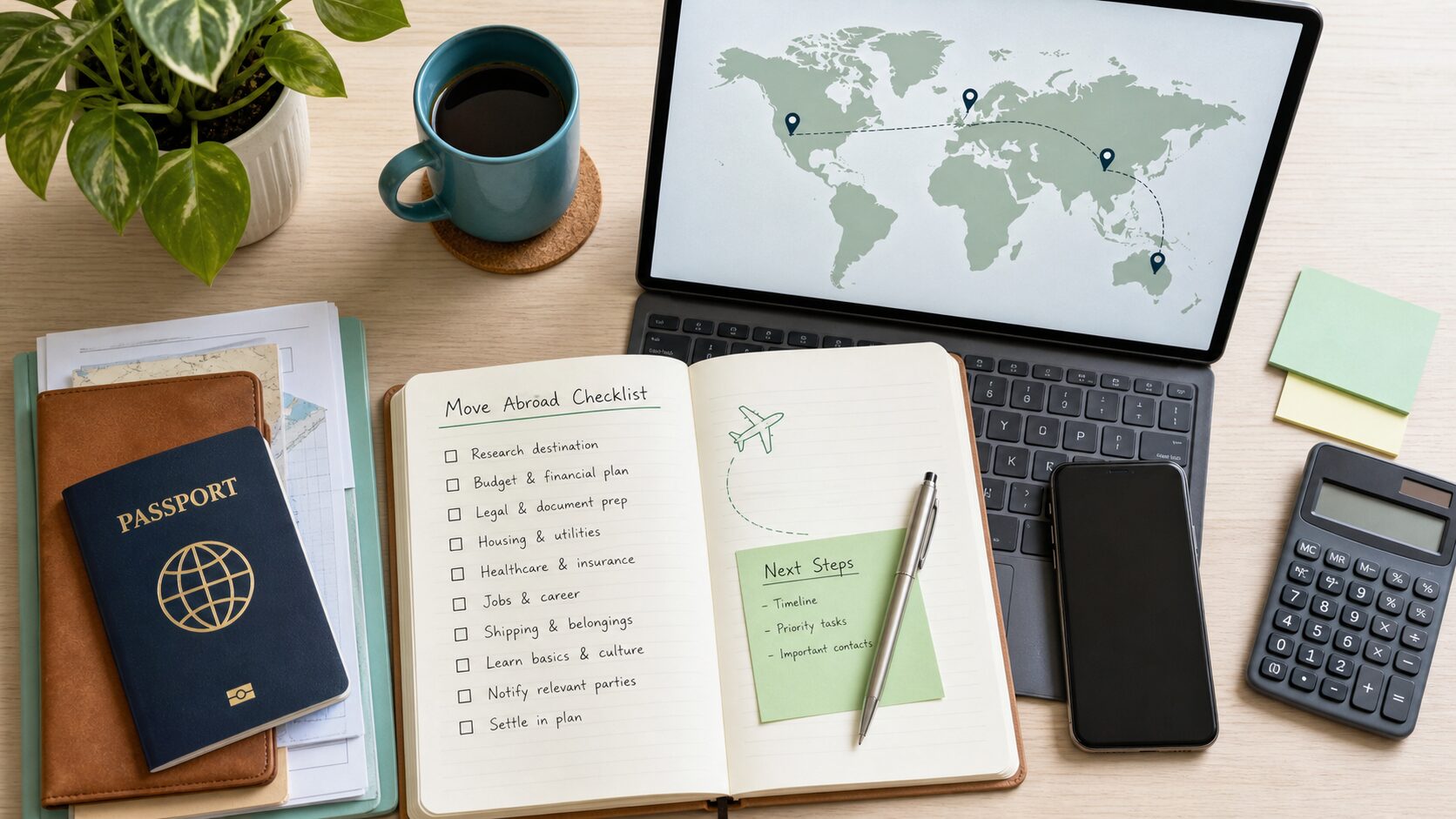
Moving abroad can look like one giant decision.
It is not.
It is a series of smaller decisions that need to work together.
You need a country you actually want to live in, but you also need a legal way to stay there. Your income has to survive the move. Your budget has to reflect real housing, healthcare, tax, transportation, and travel costs. Your daily life has to work after the vacation feeling wears off.
That is why learning how to move abroad is less about finding one perfect destination and more about researching the right questions in the right order.
You do not need to solve everything today. You need to identify the next decision that could either move your plan forward or reveal that an option is not realistic.
This guide will walk you through that process step by step.
The quick answer
A practical move abroad plan usually follows this order:
- Define the life you are trying to build.
- Decide whether you want a temporary experiment or a long-term move.
- Create a shortlist of realistic countries.
- Verify visas and residency options.
- Confirm how you will earn income.
- Build a complete moving and living budget.
- Research healthcare and insurance.
- Compare cities, neighborhoods, climate, and daily life.
- Plan temporary and long-term housing.
- Organize taxes, banking, mail, phones, and documents.
- Build a departure timeline and test your assumptions.
- Create an emergency and return plan.
Skipping steps does not make the move easier. It usually means the skipped questions return later, when they are more expensive and harder to solve.
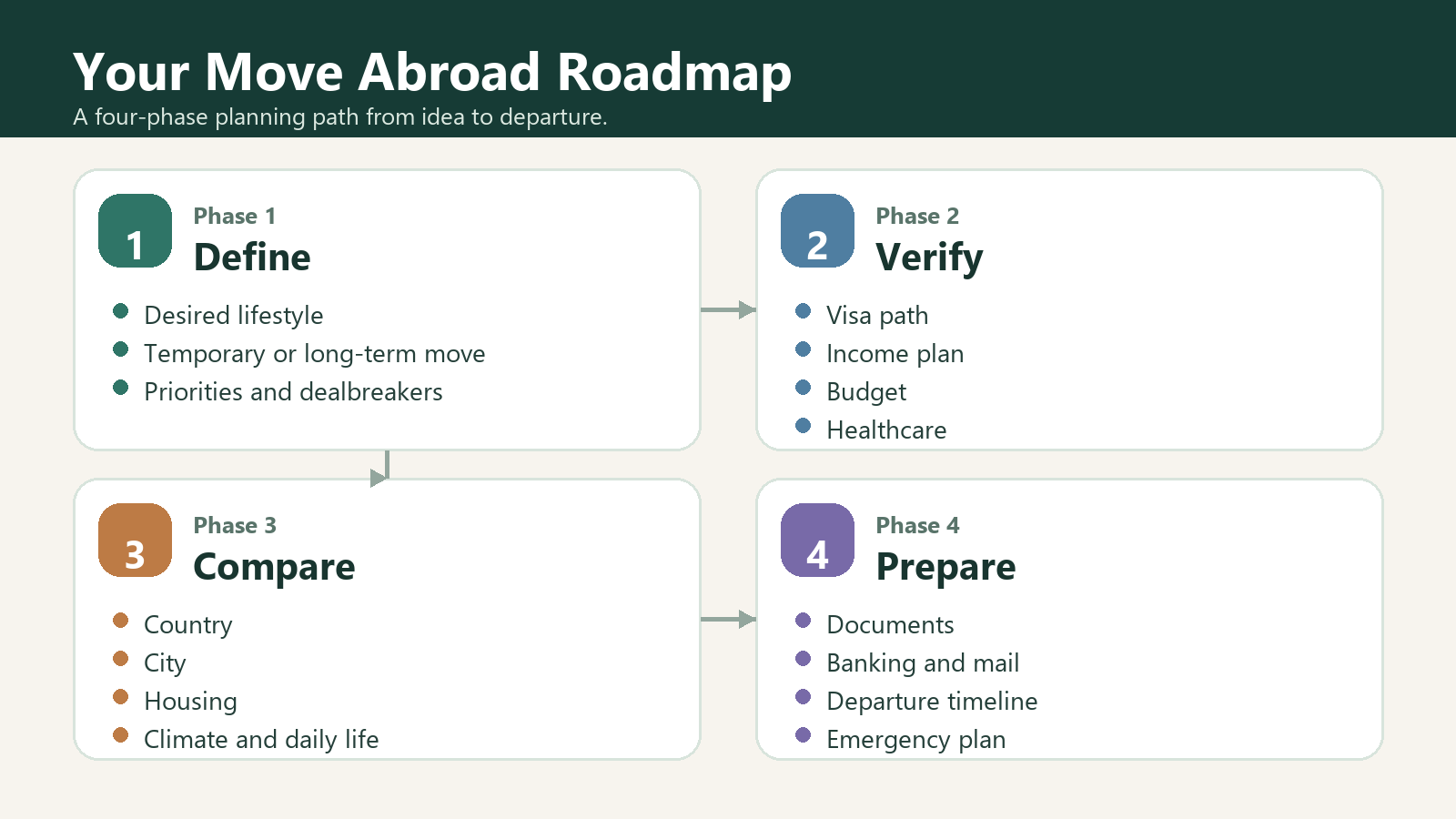
A practical move abroad planning framework
| Phase | Main question | What you should know before moving forward |
|---|---|---|
| Vision | What kind of life am I trying to build? | Your priorities, dealbreakers, family needs, and desired pace of life |
| Feasibility | Can I legally and financially make the move? | Visa path, income plan, tax questions, healthcare, and estimated budget |
| Destination | Where would my real daily life work? | Country, city, neighborhood, climate, housing, transportation, and community fit |
| Execution | How will I complete the move safely? | Timeline, documents, banking, mail, arrival housing, emergency funds, and backup plan |
Step 1: Start with the life you want
A common mistake is choosing a country before defining what you want your life to look like.
A beautiful destination can still be wrong for you.
Before comparing countries, describe the life you are trying to build.
Consider:
- Do you want a busy city, a smaller town, or a quieter rural area?
- Do you want to walk and use public transportation, or are you comfortable owning a car?
- Do you want warm weather all year, four seasons, mountain air, or coastal humidity?
- How close do you need to be to an international airport?
- How often do you expect to return to the United States?
- Do you need access to specialized healthcare?
- Are schools, childcare, or university options part of the decision?
- Do you want an established international community?
- How comfortable are you learning and using another language?
- Do you want a temporary adventure or a place where you could stay for years?
- What level of bureaucracy and uncertainty can you realistically tolerate?
Separate your answers into three categories:
Priorities
These are features that strongly influence your quality of life but may allow some flexibility.
Examples include:
- Walkability
- Good public transportation
- Warm weather
- Outdoor activities
- Cultural events
- Access to an airport
- Affordable dining
- A slower pace of life
Dealbreakers
These are conditions that could eliminate a country or city from consideration.
Examples include:
- No realistic visa path
- Inability to keep your job
- Healthcare that cannot support a known need
- Housing costs outside your budget
- Extreme heat or cold
- Poor accessibility
- Lack of appropriate schools
- Distance from family that feels unmanageable
Preferences
These are things you would enjoy but should not outweigh legal, financial, or practical realities.
Examples include:
- A beach nearby
- Historic architecture
- A large English-speaking community
- Particular foods
- A favorite travel experience
- A city that photographs beautifully
The MoveMap quiz can help you organize lifestyle priorities, risk tolerance, income questions, climate preferences, and planning style before you choose a country.
Step 2: Decide what kind of move you are planning
“Moving abroad” can describe very different plans.
You might be considering:
- A one-to-three-month test
- A seasonal stay
- Six months abroad
- A one-year remote-work experiment
- A temporary employment assignment
- A retirement move
- A move tied to a spouse or partner
- A local job in another country
- A long-term residence plan
- A possible path to permanent residency or citizenship
The length and purpose of your move influence nearly every other decision.
A tourist stay may require less preparation than a permanent relocation, but it may not permit the work or lifestyle you have in mind. A temporary visa may support a one-year experiment without creating a long-term residency path. A country that works for retirement may not work for someone seeking local employment.
Write down:
- How long you initially want to stay
- Whether you want the option to remain longer
- How you expect to support yourself
- Who is moving with you
- Whether you need work rights
- Whether long-term residency matters
- What would cause you to return to the United States
You can change your mind later. The point is to research a real scenario instead of a vague dream.
Step 3: Build a shortlist instead of researching the whole world
Trying to compare every possible country is a reliable way to become overwhelmed.
Start with three to five countries.
A useful shortlist should include:
- One country you feel strongly drawn toward
- One country that appears especially practical
- One country that challenges your assumptions
- One backup option with a different visa, budget, or regional profile
Compare each country using the same criteria:
- Visa and residency fit
- Work and income fit
- Estimated cost of living
- Housing availability
- Healthcare
- Climate and environmental conditions
- Language
- Transportation
- Safety and local conditions
- Distance from the United States
- Flight availability
- Time-zone difference
- Family considerations
- Pet requirements
- Tax complexity
- Long-term residency options
- Biggest known risk
- Biggest unanswered question
Use the MoveMap country guides to begin that comparison. Current guides include Australia, Mexico, Portugal, and Spain, with additional destinations to be added over time.
Do not choose a country simply because it wins the most categories. Some factors are more important than others.
A country with a slightly higher cost of living may still be the better choice if it offers a workable visa, stronger employment options, reliable healthcare, and a daily routine that fits you.
For the full comparison method, read How to Choose Countries to Compare Before You Move Abroad.
Step 4: Verify the legal path before becoming emotionally committed
Visiting a country is not the same as living there.
Tourist entry does not automatically provide the right to work, remain long term, enroll in local systems, or repeatedly leave and return without restriction.
Before treating a destination as a serious option, identify the visa or residence category that would apply to your actual situation.
Possible paths may include:
- Remote-worker or digital-nomad visas
- Employer-sponsored visas
- Skilled-worker programs
- Retirement or passive-income visas
- Self-employment or entrepreneur visas
- Student visas
- Family or partner visas
- Ancestry or citizenship-by-descent routes
- Temporary residence permits
- Permanent residence programs
For each possible path, verify:
- Who is eligible
- Whether remote or local work is permitted
- Minimum income or savings requirements
- Health-insurance requirements
- Background-check requirements
- Document legalization or apostille requirements
- Whether family members are included
- Whether a spouse or partner can work
- Initial approval length
- Renewal rules
- Minimum physical-presence rules
- Local registration requirements
- Whether the route can lead to permanent residency
- Whether current processing times fit your plan
Use official immigration authorities, consulates, embassies, and government portals as the source of truth. The U.S. State Department international travel resources can also help you find destination-specific official guidance before a move.
Blogs, videos, social posts, and online communities can help you discover questions. They should not be the final authority for immigration decisions.
Read The Visa Reality Check: Why You Can’t Pick a Country on Vibes Alone before making a final shortlist.
Step 5: Confirm how your income will work
A move cannot rely on income that disappears when you cross a border.
Your income plan may involve:
- Keeping a U.S. remote job
- Finding a local job
- Freelancing
- Running a business
- Receiving retirement income
- Living on investment or passive income
- Studying while working within permitted limits
- Relying on a spouse or partner’s income
- Using savings for a defined period
Each path creates different questions.
Keeping a remote job
Employer approval matters.
A manager informally saying yes may not resolve payroll, tax, employment-law, data-security, benefits, insurance, or corporate-registration concerns.
Ask your employer:
- Is international remote work allowed?
- Which countries are approved or prohibited?
- How long may I work abroad?
- Does HR, payroll, legal, tax, or security need to approve the arrangement?
- Will my compensation or benefits change?
- Are there restrictions involving customer data, regulated information, or company devices?
- Can I receive approval in writing?
Read Can I Really Work Remotely From Another Country? for a more complete remote-work review.
Finding local employment
Research:
- Whether your visa permits work
- Whether sponsorship is required
- Whether your profession is regulated
- Whether credentials transfer
- Whether the local language is required
- Typical hiring timelines
- Local salary ranges
- Payroll deductions
- Employment protections
- Whether your expected salary supports the lifestyle you are researching
Do not compare a U.S. salary with foreign living costs if your actual plan requires earning a local salary.
Freelancing or running a business
Check:
- Whether the visa allows self-employment
- Local business-registration requirements
- Tax and social-contribution obligations
- Invoicing rules
- Banking and payment processing
- Whether your clients create local tax or registration issues
- Whether a physical business address is required
- Whether professional licenses are needed
Income fit is not only about whether money reaches your bank account. It is about whether the way you earn it is legal, sustainable, and compatible with the country’s rules.
Step 6: Build a complete move abroad budget
A cost-of-living estimate is not a moving budget.
You need to estimate both:
- What it costs to complete the move
- What it costs to live after arriving
One-time moving costs
Possible expenses include:
- Passport renewal
- Visa and residence applications
- Certified copies
- Apostilles and document legalization
- Translations
- Background checks
- Medical exams
- Professional immigration or tax help
- Scouting trip
- Flights
- Extra baggage
- Pet transportation
- Shipping
- Storage
- Temporary housing
- Rental deposit
- Utility deposits
- Household setup
- Local transportation
- Vehicle purchase or rental
- School enrollment costs
- Phone and internet setup
- Emergency travel
- Currency conversion and transfer fees
Ongoing living costs
Estimate:
- Rent
- Utilities
- Internet
- Mobile service
- Groceries
- Dining
- Public transportation
- Vehicle expenses
- Healthcare
- Insurance
- Medication
- Childcare
- Schooling
- Taxes
- Social contributions
- Visa renewals
- Flights home
- Entertainment
- Household maintenance
- Currency changes
- Emergency savings
Use city-level estimates whenever possible.
A national average can hide enormous differences between capital cities, popular coastal areas, smaller regional cities, and rural communities.
Build three versions of your budget:
- Expected case
- Higher-cost case
- Emergency case
Do not build a plan that works only if every estimate is correct and nothing goes wrong.
Step 7: Research healthcare before you need it
Healthcare research should happen before you choose a destination, especially if anyone in the household has ongoing medical needs.
Find out:
- Whether residents are eligible for the public system
- When eligibility begins
- Whether your visa requires private insurance
- Whether private insurance must meet specific standards
- Whether preexisting conditions are covered
- How prescriptions are handled
- Whether your medications are available and legal
- How primary and specialist care is accessed
- Typical wait times
- Emergency-care procedures
- Mental-health access
- Dental and vision coverage
- Maternity and pediatric care
- Accessibility
- Medical evacuation options
The CDC destination pages can help identify health risks, vaccination guidance, and destination-specific considerations before travel.
People using Medicare should verify coverage carefully. Medicare generally provides limited coverage outside the United States, with only specific exceptions and possible supplemental coverage.
Health insurance, travel insurance, and medical evacuation coverage are not automatically the same thing.
Read the policy language instead of relying only on the product name.
Step 8: Compare climate, cities, and daily life
Choosing a country is not enough.
Your experience will be shaped by the specific city, neighborhood, housing, transportation, climate, and social environment you choose.
Compare possible locations using:
- Housing cost and availability
- Neighborhood safety
- Walkability
- Public transportation
- Driving requirements
- Distance to healthcare
- Airport access
- Internet reliability
- Coworking options
- Schools and childcare
- Grocery access
- Language use
- Noise
- Tourism levels
- Air quality
- Flood, fire, storm, earthquake, or heat risks
- Community and social opportunities
- Accessibility
- Pet friendliness
- Seasonal changes
Climate deserves more attention than an annual average temperature.
Research:
- Monthly highs and lows
- Humidity
- Rainy and dry seasons
- Heating and cooling norms
- Indoor temperature and building quality
- Mold and moisture
- Air pollution
- Wildfire smoke
- Flooding
- Severe storms
- Altitude
- Seasonal daylight
- Allergy conditions
Read Climate, Comfort, and Daily Life: What People Forget Before Moving Abroad before assuming pleasant vacation weather will feel good year-round.
Step 9: Plan housing in two stages
You do not necessarily need to sign a long-term lease before arriving.
In many cases, a safer approach is:
Stage 1: Temporary arrival housing
Book enough time to:
- Complete local registrations
- Open accounts
- Explore neighborhoods
- View properties
- Understand transportation
- Confirm commute times
- Learn rental practices
- Avoid choosing a long-term home under immediate pressure
Stage 2: Long-term housing
Before signing, confirm:
- Whether the lease is legally valid
- What identification and residency documents are required
- Deposit amount
- Advance-rent expectations
- Guarantor requirements
- Utilities included
- Furnished or unfurnished status
- Heating and cooling
- Internet availability
- Maintenance responsibility
- Pet rules
- Termination clauses
- Inventory and condition documentation
- Neighborhood noise
- Flood or weather exposure
- Transportation access
Be cautious about sending large payments for properties you have not verified.
A home that looks affordable may require expensive furniture, appliances, transportation, heating, cooling, or repairs.
Your housing decision should be based on total daily-life cost, not rent alone.
Step 10: Organize taxes, banking, mail, phones, and documents
The less exciting systems often determine whether the move feels manageable.
Taxes
Americans living abroad may continue to have U.S. tax filing obligations. The IRS provides guidance for U.S. citizens and resident aliens abroad and separate guidance on filing requirements for citizens and residents abroad.
Foreign income, foreign accounts, state residency, self-employment, payroll, tax treaties, foreign tax credits, and exclusions may all require review.
Moving abroad does not automatically end U.S. federal filing responsibilities.
It also does not automatically end residency in a particular state.
Consult qualified professionals when your tax situation is complex. Use official IRS guidance as your starting point.
Banking and money
Before leaving:
- Tell financial institutions about the move when required
- Ask whether accounts can remain open with an international residence
- Confirm how replacement cards will be delivered
- Keep more than one payment method
- Understand foreign transaction fees
- Compare international transfer options
- Confirm two-factor authentication will work abroad
- Keep access to a U.S. phone number if necessary
- Research local account requirements
- Plan how you will pay deposits and setup costs
- Avoid relying on a single bank or card
Decide whether you will use:
- USPS forwarding
- A virtual mailbox
- A trusted contact
- An existing U.S. address
- Direct international forwarding
- A combination of these options
USPS forwarding is a transition tool, not a complete long-term mail system. Read Mail Forwarding When Moving Abroad: What Happens to Your U.S. Mail? and complete the setup before leaving the United States.
Phones and online accounts
Check:
- Whether your phone is unlocked
- Whether your number needs to remain active
- International roaming
- Local SIM or eSIM options
- Two-factor authentication
- Password-manager access
- Banking verification
- Employer security requirements
- Emergency contacts
- Cloud backups
- Device replacement options
Documents
Create secure physical and digital copies of:
- Passports
- Birth certificates
- Marriage or divorce records
- Custody documents
- Adoption records
- Driver’s licenses
- Education records
- Professional licenses
- Employment records
- Tax records
- Background checks
- Medical records
- Vaccination records
- Prescriptions
- Insurance policies
- Pet records
- Visa applications
- Lease documents
- Emergency contacts
Some documents may need certification, notarization, translation, legalization, or an apostille. Verify the destination’s exact requirements before ordering services.
Step 11: Build a departure timeline
Work backward from your expected departure date.
Your timeline may need to account for:
- Passport processing
- Visa appointments
- Background checks
- Apostilles
- Document translations
- Medical exams
- Employer approval
- Notice to a landlord or home sale
- School schedules
- Pet requirements
- Shipping
- Storage
- Insurance
- Mail setup
- Prescription refills
- Temporary housing
- Flight prices
- Tax appointments
- Account closures
- Utility cancellation
- Vehicle sale
- Farewell and family logistics
Six to twelve months before
- Define your move
- Narrow the country shortlist
- Research visa paths
- Confirm income feasibility
- Estimate the budget
- Review passport expiration
- Identify long-lead documents
- Begin discussing the move with employers and family
Three to six months before
- Submit applications when permitted
- Order background checks and official records
- Research temporary housing
- Compare insurance
- Plan schooling and pets
- Decide what to sell, ship, store, or donate
- Begin direct address updates
- Create an emergency fund
One to three months before
- Confirm visas and travel documents
- Book flights and arrival housing
- Arrange mail handling
- Prepare banking and phone access
- Gather medication and medical records
- Finalize insurance
- Notify required organizations
- Back up documents
- Confirm arrival transportation
Final two weeks
- Test payment methods
- Confirm account access
- Verify flight and entry requirements
- Save copies of reservations
- Reconfirm temporary housing
- Share the itinerary with trusted contacts
- Pack essential documents in carry-on luggage
- Review emergency contacts
- Confirm your first 72 hours after arrival
Use the State Department’s current international travel checklist and destination information before departure.
Step 12: Create an emergency and return plan
A backup plan does not mean you expect the move to fail.
It means one difficult event does not have to become a crisis.
Plan for:
- Emergency flights
- Loss of employment
- Visa denial or nonrenewal
- Medical emergencies
- Family emergencies in the United States
- Housing loss
- Theft or loss of documents
- Natural disasters
- Political instability
- Relationship changes
- Currency shifts
- A destination that simply does not fit
Keep:
- An emergency fund that is separate from routine spending
- Copies of important documents
- More than one payment method
- Emergency contacts in both countries
- Access to U.S. accounts
- A place you could stay temporarily
- A plan for belongings
- A plan for pets
- Enough flexibility to change course
Consider enrolling in the State Department’s Smart Traveler Enrollment Program when appropriate so you can receive relevant messages from the nearest U.S. embassy or consulate. You can find STEP through the State Department international travel resources.
You are allowed to test a move without promising that it will be permanent.
Returning home, choosing another country, or changing your plan is not failure. It is information.
How to move abroad without researching everything at once
You do not need to know every law, neighborhood, insurance product, tax form, and visa route before taking the first step.
Use a decision filter.
Ask:
- What is the next major assumption my plan depends on?
- What official source can confirm it?
- What result would eliminate this option?
- What result would justify deeper research?
- What action can I take this week?
For example:
- If your plan depends on keeping your job, confirm employer approval before comparing apartments.
- If your plan depends on a retirement visa, verify the visa requirements before planning a scouting trip.
- If healthcare is a dealbreaker, research access before comparing beach towns.
- If the move only works below a certain budget, build the realistic budget before paying for applications.
- If you are still comparing countries, use the same worksheet and criteria for each one.
The MoveMap Toolkit is being built to help organize this process with readiness checks, country comparisons, visa questions, remote-work reviews, cost planning, climate research, and relocation checklists.
Your move abroad starting checklist
Before calling a country your destination, confirm that you have:
- Defined your lifestyle priorities
- Identified your dealbreakers
- Decided whether the move is temporary or long term
- Narrowed the list to three to five countries
- Identified a possible visa or residency path
- Confirmed whether your income can continue
- Estimated both moving costs and monthly expenses
- Researched healthcare and insurance
- Compared specific cities and neighborhoods
- Reviewed climate and seasonal conditions
- Planned temporary arrival housing
- Identified tax questions
- Created a banking and payment plan
- Created a mail plan
- Checked passport and document requirements
- Built a realistic timeline
- Saved emergency and return funds
- Written down the biggest unanswered question
You do not need perfect certainty.
You need enough verified information to know whether the next step is responsible.
The bottom line
Learning how to move abroad is not about discovering a country with no tradeoffs.
Every destination has tradeoffs.
The goal is to find a place where the legal path, income, budget, healthcare, housing, climate, logistics, and daily life work well enough for the life you want to build.
Start with your priorities. Test the visa and income assumptions early. Compare countries using the same criteria. Use official sources for high-stakes decisions. Build a budget with room for surprises. Create a backup plan.
Then take the next practical step.
Take the MoveMap quiz if you are still deciding what kind of destination may fit you.
Explore the MoveMap country guides if you are ready to compare specific options. Current starter guides include Portugal, Spain, Mexico, Australia, and Canada.
Join the MoveMap Toolkit waitlist if you want structured worksheets and checklists for organizing your research.