
Mail is boring right up until the envelope contains a tax notice, a replacement credit card, a check, or a document you need from thousands of miles away.
That is why mail forwarding when moving abroad needs more thought than submitting one form and hoping everything follows you forever.
The United States Postal Service can forward some mail to a new address, including an international address when the request is completed correctly. But USPS forwarding is not a permanent mail-management system. Some mail may not be forwarded, different classes of mail have different forwarding periods, and certain senders may instruct USPS not to forward their envelopes.
A reliable plan usually combines several things:
- A temporary USPS change of address
- A long-term place to receive U.S. mail
- Direct address updates with important organizations
- Paperless delivery wherever possible
- A backup plan for urgent or sensitive documents
Here is how to decide which setup makes sense for your move.
Mail is one part of the larger relocation plan covered in the How to Move Abroad guide.
The quick answer
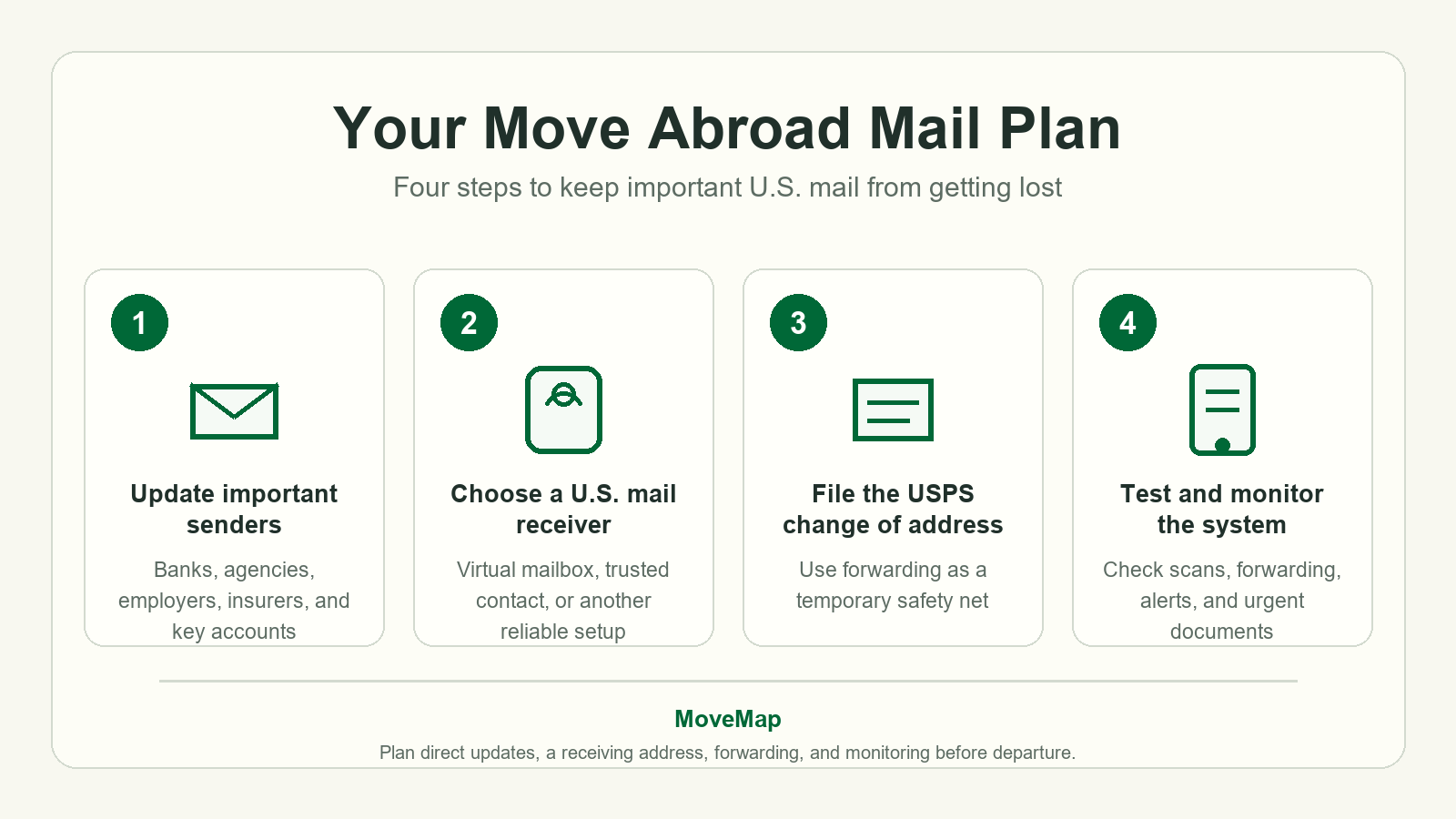
For most people making a long-term international move, the strongest setup is:
- Choose a virtual mailbox, trusted contact, or other reliable U.S. mail receiver.
- Update banks, government agencies, employers, insurers, and other important senders directly.
- File a USPS change of address as a temporary safety net.
- Switch routine statements and notices to paperless delivery.
- Test the system before leaving the United States.
USPS forwarding can catch mail you forgot about, but it should not be the only thing standing between you and a missed tax notice.
What USPS mail forwarding actually does
A USPS change of address tells the Postal Service to reroute eligible mail sent to your old address.
A change of address can be temporary or permanent.
USPS says a temporary change of address can run for at least 15 days and generally no longer than 364 days. This may work for an extended trial stay, seasonal move, or temporary assignment abroad.
For a permanent change of address, USPS primarily forwards First-Class Mail for 12 months and periodicals for 60 days. Treatment of packages, marketing mail, and other mail classes can vary, so check the current USPS mail forwarding options before relying on a specific mail class.
That gives you time to find forgotten senders and update them directly. It does not mean your old address will continue working indefinitely.
USPS also warns that some businesses, financial institutions, and government agencies place special instructions on their mail. Those instructions may prevent an item from being forwarded. USPS gives driver’s licenses and bank statements as examples of mail that may not follow an ordinary forwarding order.
The practical lesson is simple:
Forwarding is a bridge between addresses, not a permanent address strategy.
Moving to another country requires an in-person USPS request
An international move is handled differently from a normal domestic change of address.
USPS currently says that a change of address to an international address cannot be submitted online. You must visit a local Post Office, complete PS Form 3575, provide the required identification, and finish identity verification before leaving the United States.
Do not save this task for your first week abroad.
If you leave without filing the request, USPS says you may need to notify senders individually or authorize someone else to submit the form on your behalf with appropriate documentation.
Add the Post Office visit to your departure checklist while you are still physically in the United States.
Your main options for handling U.S. mail abroad
There is no single correct mail setup for every international move.
The right option depends on how long you will be away, how much physical mail you receive, whether you need a continuing U.S. mailing address, and how often you expect packages or sensitive documents.
Option 1: Forward mail directly to your international address
You can ask USPS to forward eligible mail from your U.S. address to an international address.
This may be reasonable when:
- Your overseas address is stable
- You receive very little physical mail
- You do not need someone to inspect or scan envelopes
- International delivery times are acceptable
- You are comfortable paying any applicable forwarding or international postage
- The destination has reliable mail delivery
The drawbacks are significant.
International delivery can be slow. Your address may change after you arrive. Some mail will not forward. You also lose the ability to quickly inspect an envelope before deciding whether it needs immediate attention.
Direct international forwarding may help during the transition, but it is often less flexible than maintaining a reliable mail receiver in the United States.
Option 2: Use a virtual mailbox
A virtual mailbox gives you a U.S. mailing address where a company receives mail on your behalf.
Depending on the provider and plan, available services may include:
- Scanning the outside of envelopes
- Opening and scanning selected mail with your authorization
- Secure shredding
- Forwarding selected letters
- Consolidating mail into fewer shipments
- Receiving or forwarding packages
- Depositing certain checks
These features are provider-specific. Verify exactly what is included before paying for a plan.
Many virtual mailbox businesses operate as Commercial Mail Receiving Agencies, commonly called CMRAs. USPS generally requires customers receiving mail through a CMRA to complete PS Form 1583 and provide acceptable identification. The signature may need to be witnessed by the mail agent or acknowledged before an eligible notary.
Complete that process before your departure whenever possible. Waiting until you are abroad can make identity verification and document handling more complicated.
A virtual mailbox can be convenient, but it does not automatically become your legal residence, tax domicile, voter residence, or physical residential address. Some banks, insurers, government agencies, and state systems may require a true residential address and may not accept a PO Box or CMRA address as your only address.
Ask each institution what it requires rather than assuming one address will work everywhere.
Option 3: Use a trusted friend or family member
A trusted person in the United States can receive your mail, tell you what arrived, scan documents, and forward important items.
This can be inexpensive and flexible.
It can also become a recurring favor that lasts much longer than anyone expected.
Before using someone’s address, agree on:
- How often they will check the mail
- Whether they may open envelopes
- How sensitive information will be handled
- How scans will be sent securely
- Who pays forwarding and shipping costs
- Whether they will accept packages
- What happens if they move
- How long the arrangement will last
- Which address uses are permitted
Do not list someone’s home as your legal residence, business location, or permanent physical address without their permission and without confirming that the use is accurate.
Receiving mail is one thing. Representing that you physically live somewhere is another.
Option 4: Keep access to an existing U.S. address
You may continue using an existing address if you are keeping your U.S. home, maintaining a legitimate residence, or have another reliable arrangement.
This can reduce disruption, but someone still needs to collect and manage the mail while you are away.
A locked mailbox filling up for six months is not a mail plan.
A standalone PO Box has the same basic limitation. It receives mail, but it does not scan, open, or forward items by itself. You will still need a person or service to manage it, and some organizations will not accept a PO Box as a residential address.
Comparing your mail options
| Option | Best for | Main advantage | Main limitation |
|---|---|---|---|
| International USPS forwarding | Short transitions with a stable overseas address | Mail can follow you without a separate U.S. service | Not all mail forwards, and international delivery may be slow |
| Virtual mailbox | Long-term movers who want remote access | Envelope scans and selective forwarding | Monthly cost and possible address restrictions |
| Trusted contact | People with a reliable person in the United States | Flexible and potentially inexpensive | Privacy, burden, and dependence on one person |
| Existing U.S. address or PO Box | People keeping a legitimate U.S. base | Familiar address with less account disruption | Someone still has to collect and manage the mail |
A mailing address is not the same as legal residence
One of the easiest mistakes is treating every address question as the same question.
They are not the same.
You may encounter requests for:
- Mailing address
- Physical residential address
- Permanent address
- Legal domicile
- Tax residence
- Voting residence
- Business address
- Registered-agent address
- Address used for a driver’s license
- Address used by a bank for identity verification
A virtual mailbox may work perfectly as a mailing address and still be inappropriate for another purpose.
Keeping a U.S. mailing address also does not automatically preserve or end residency in a particular state. State tax residency and domicile can depend on a much larger set of facts, including your home, family connections, licenses, voter registration, property, employment, time spent in the state, and intent.
Use truthful addresses and get qualified legal or tax advice when residency has financial or legal consequences.
Update important senders directly
Do not wait for forwarded mail to reveal every account you forgot.
Start tracking physical mail at least one month before your move. Every time something arrives, ask whether you can switch it to paperless delivery or update the address directly.
Government and public agencies
Depending on your situation, review:
- Internal Revenue Service
- Social Security Administration
- State tax agency
- Department of Motor Vehicles
- Voter registration office
- Professional licensing boards
- Veterans Affairs
- Immigration agencies
- Courts or other agencies involved in an active matter
The IRS provides Form 8822 for individuals changing a home mailing address. Businesses generally use Form 8822-B for a business mailing address, business location, or responsible-party change.
If you receive Social Security benefits and move abroad, the Social Security Administration says you should report your address change even if payments are deposited directly into a bank account.
An already issued U.S. passport does not need to be updated merely because your address changed. If a passport application is still being processed, update the mailing address through the State Department’s current instructions.
Requirements can change, so confirm each process through the agency’s official website.
Banks, credit cards, and investments
Update:
- Banks
- Credit unions
- Credit-card companies
- Brokerages
- Retirement accounts
- Mortgage companies
- Student-loan providers
- Personal lenders
- Payment services
Ask whether the institution allows an international residential address, requires a separate U.S. mailing address, or restricts accounts held by customers living in certain countries.
Do not assume that changing a mailing address answers the institution’s residency questions.
Also ask how replacement cards, security notices, tax documents, and identity-verification letters will be delivered.
Employment and business records
Update:
- Employer and payroll department
- Benefits administrator
- Clients
- Business bank
- Payment processors
- State business registration
- Registered agent
- Business insurers
- Licensing agencies
- IRS business records when applicable
Your business mailing address, registered-agent address, and actual operating location may be different. Keep each record accurate.
For broader employment planning, read Can I Really Work Remotely From Another Country?
Insurance and healthcare
Review addresses associated with:
- Health insurance
- Life insurance
- Homeowners or renters insurance
- Auto insurance
- Disability insurance
- Medical providers
- Dental providers
- Pharmacies
- Health savings accounts
- Flexible spending accounts
Your move may affect more than the mailing address. Coverage itself may change when you live outside the United States.
Personal accounts
Do not forget:
- Schools and universities
- Membership organizations
- Subscription boxes
- Magazine subscriptions
- Charities
- Alumni groups
- Utility companies
- Mobile-phone provider
- Storage facility
- Friends and family
Cancel physical mail that no longer provides any value.
Packages need a separate plan
Letters and packages are not the same logistical problem.
Before selecting a mail service, ask:
- Does it accept packages from USPS, UPS, FedEx, and other carriers?
- Are there package-size or weight limits?
- How long is storage included?
- Can multiple packages be consolidated?
- What are the handling fees?
- Does the provider ship internationally?
- Who completes customs information?
- What happens to prohibited or restricted items?
- Can the provider return an unwanted package?
International package forwarding can become expensive quickly.
Whenever possible, buy ordinary household items in your destination country rather than repeatedly forwarding them from the United States. Save international forwarding for items that are genuinely difficult to replace.
Test the system before you leave
Do not let the first important envelope become your test case.
After setting up your mailbox or trusted-contact arrangement:
- Mail yourself a basic envelope.
- Confirm that it arrives at the new U.S. receiving address.
- Test the scan or notification process.
- Request one low-priority forwarding shipment.
- Confirm how long processing and delivery take.
- Save account numbers, login details, and customer-support information.
- Make sure a spouse or partner can access the service if needed.
A small test can expose a bad setup before it becomes an expensive problem.
A 30-day mail forwarding plan
About 30 days before leaving
- Track every piece of physical mail that arrives
- Switch routine statements to paperless delivery
- Compare virtual mailboxes or confirm a trusted contact
- Check which organizations require a residential address
- Gather identification needed for mailbox setup
- Complete PS Form 1583 if using a CMRA
- Update important financial and government accounts
About two weeks before leaving
- File the USPS international change of address in person
- Save the USPS confirmation information
- Test your receiving address
- Confirm package and forwarding procedures
- Give trusted contacts clear written instructions
- Update your employer, insurers, lenders, and service providers
During the first three months abroad
- Review mail notifications regularly
- Update every sender whose mail was forwarded
- Watch for government and financial mail
- Remove junk mail and unnecessary subscriptions
- Confirm that replacement cards and tax forms can reach you
- Reassess whether your chosen service still fits your needs
The goal is to receive less physical mail over time, not to forward the same pile forever.
Which mail setup fits your move?
A short international stay may only require a temporary change of address and a trusted person checking your mail.
A six-month or one-year experiment may justify a virtual mailbox, especially if your overseas housing could change.
A permanent move usually needs a stable long-term mail receiver, direct account updates, digital delivery, and a plan for institutions that require a physical residential address.
A business owner may need a separate business-mail setup, registered agent, tax-address update, and plan for checks, legal notices, and customer correspondence.
Your mail plan should answer seven questions:
- Where will U.S. mail be delivered?
- Who can see and open it?
- How will you receive scans?
- How will urgent documents reach you?
- How will packages be handled?
- Which organizations need a physical residential address?
- What happens if the mailbox service or trusted-contact arrangement ends?
If any answer is “we will figure it out later,” figure it out before the flight.
The bottom line
Mail forwarding when moving abroad is not just a Post Office form.
USPS forwarding can help catch forgotten mail, but it has limits. A complete plan also requires a dependable receiving address, direct updates with important senders, digital statements, package planning, and a clear distinction between your mailing address and your actual legal or residential address.
Handle it while you are still in the United States.
Future you does not want to spend a Tuesday night in another time zone trying to locate a tax letter sitting in an overflowing mailbox.
Use the MoveMap Toolkit to organize mail, banking, phone, insurance, tax, and other relocation tasks. If you are still deciding where to move, take the MoveMap quiz and browse the MoveMap country guides to start narrowing your options.