
A country shortlist should make your decision easier.
Most relocation shortlists do the opposite.
They mix places chosen for different reasons, compare vacation impressions with national averages, and ignore whether you have a legal path, a workable income, a healthcare plan, or a realistic city. The result is a long list of attractive destinations with no clear way to remove one.
When you compare countries for moving abroad, the shortlist that actually helps is small, evidence based, and built around the same questions for every option.
This guide will help you choose two to four countries worth comparing before you invest serious time, money, or emotional energy in a move abroad. It goes deeper than the shortlist step in the How to Move Abroad guide, and it assumes you have not confirmed eligibility anywhere yet.
Step 1: Start with the life you are trying to build
Do not begin with a world map. Begin with the change you want the move to create.
Write one sentence that completes this prompt:
I am considering moving abroad because I want…
Useful answers might focus on:
- A calmer daily pace
- More financial breathing room
- A stable place to raise children
- A portable remote-work lifestyle
- Better access to nature
- A new cultural or language experience
- A long-term retirement base
- A bold personal reset
Then identify the conditions that must support that goal.
A calmer life may still require reliable healthcare, reasonable housing, and legal permission to earn. A lower-cost destination may fail if private school, imported medicine, air conditioning, or frequent flights erase the savings. A remote-work plan may fail if the employer says no.
The MoveMap quiz can help clarify these priorities, but a quiz result is a research starting point, not an eligibility decision or a final country choice.
Step 2: Build three different kinds of options
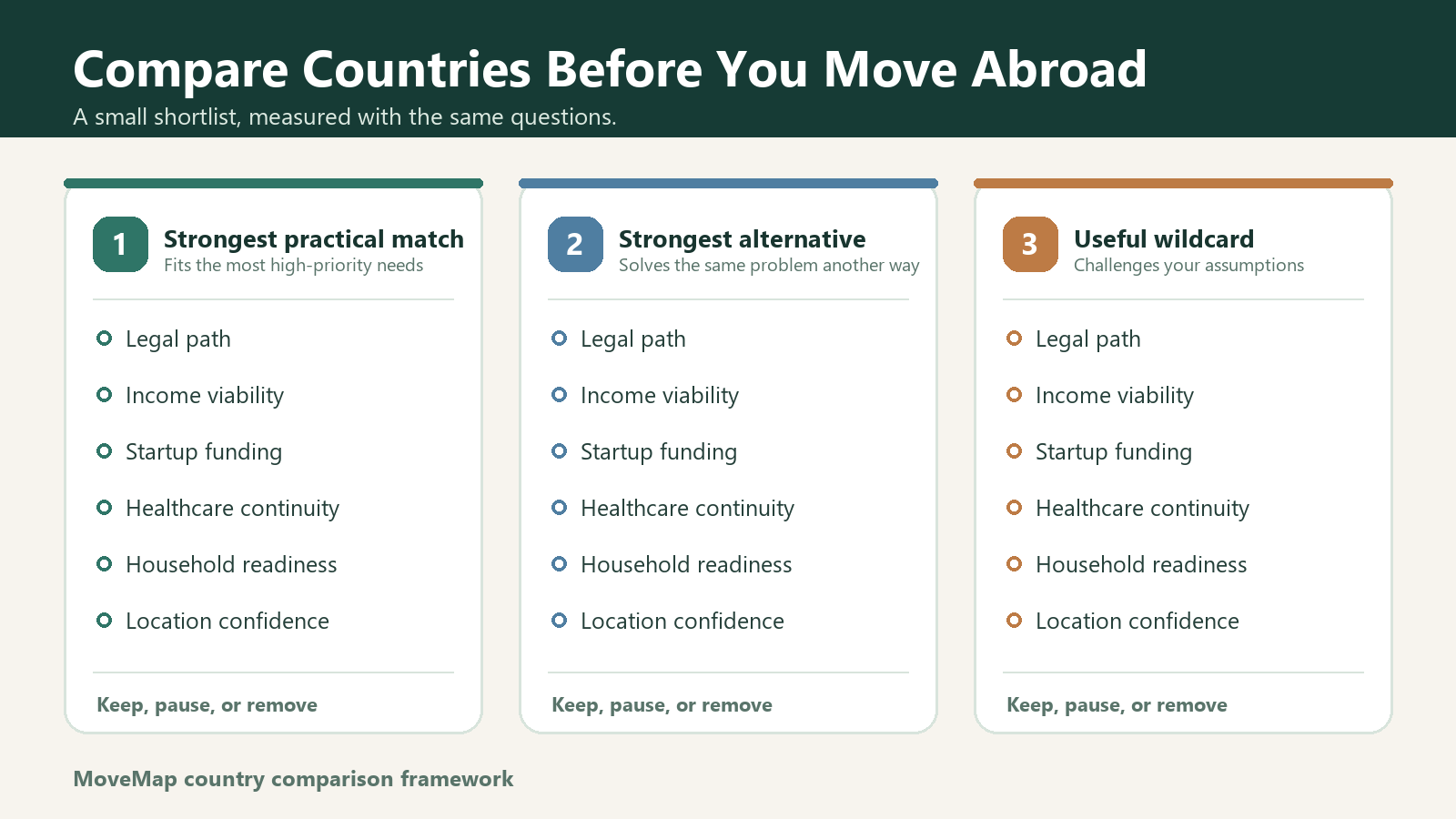
A useful shortlist is not three versions of the same idea.
Try to include:
1. The strongest practical match
This country aligns with the greatest number of your high-priority needs and does not present an obvious unresolved deal-breaker.
2. The strongest alternative
This country solves the same problem in a different way. It might be farther away but safer, more expensive but easier for work, or less familiar but stronger for healthcare.
3. The useful wildcard
This is not the country you expected to choose. It stays credible because it fits one of your highest priorities and exposes assumptions in the other options.
A fourth country is reasonable when it represents a genuinely different region, legal path, or household solution. More than four usually creates research sprawl.
Track each option with the same five notes:
| What to record | Why it matters |
|---|---|
| Country | Keeps every option in one comparable list |
| Strongest reason it is on the list | Names the specific need this country solves |
| Biggest obstacle | Surfaces the problem that could end the option |
| Evidence still needed | Turns an opinion into a research task |
| Keep, pause, or remove | Forces a decision instead of an open tab |
Step 3: Apply the legal-path test first
A destination should not stay on the shortlist simply because it looks attractive.
For each country, identify at least one residence or lawful-stay category that appears relevant enough to research further. Examples can include skilled employment, employer transfer, remote-worker stay, retirement income, independent means, study, family relationship, business, or temporary residence.
Do not decide that you qualify. Instead, record:
- The official authority
- The category name
- The main qualifying basis
- The biggest unresolved requirement
- Whether dependents can be included
- Whether the intended work is allowed
- The next official verification step
Remove or pause a country when no credible category matches the intended income, household, and timeline. The Visa Reality Check explains why this step belongs before the cost comparison rather than after it.
Step 4: Compare income before cost of living
Cost comparisons are meaningless without a post-move income model.
For every country, name the expected source:
- Existing remote employment
- Independent or business income
- Local employment
- Employer transfer
- Pension or passive income
- Savings during a temporary period
- A combination of sources
Then test the dependency.
For remote employment, confirm employer permission, payroll, benefits, insurance, data rules, immigration permission, and what happens if the job ends. The MoveMap article on working remotely from another country covers those questions in detail.
For local employment, confirm work authorization, occupation demand, language, qualification recognition, likely net pay, and housing.
For retirement or passive income, confirm whether the income is accepted, stable, documentable, and sufficient after healthcare, tax, and currency questions.
A cheap country with no workable income is not the affordable option.
Step 5: Compare the real first-year budget
Monthly cost is only one part of the financial comparison.
For each country, estimate:
- Immigration and document preparation
- Temporary housing
- Deposit and advance rent
- Flights and baggage
- Shipping, storage, replacement, or selling costs
- Insurance and healthcare transition
- Vehicle or transportation setup
- School, childcare, dependent, or pet costs
- Furniture, utilities, phone, and internet
- Emergency reserve
- Ongoing monthly expenses
- A trip back to the United States
Use the same categories for every country. A country should not win because one estimate includes only rent and groceries while another includes the full household.
Step 6: Apply six readiness gates
Give every country one status for each gate:
- Ready to work on
- Needs verification
- Potential blocker
The six gates are:
| Gate | The question it answers |
|---|---|
| Legal path | Is there a credible official category and a next verification step? |
| Income viability | Can the intended income legally and practically continue? |
| Startup funding | Can the household cover the move, the landing period, and an emergency reserve? |
| Healthcare continuity | Can the household maintain coverage, prescriptions, providers, and emergency access? |
| Household readiness | Are dependents, schooling, accessibility, pets, support networks, and documents manageable? |
| Location confidence | Is there at least one city or region where housing, climate, safety, transport, internet, and daily life align? |
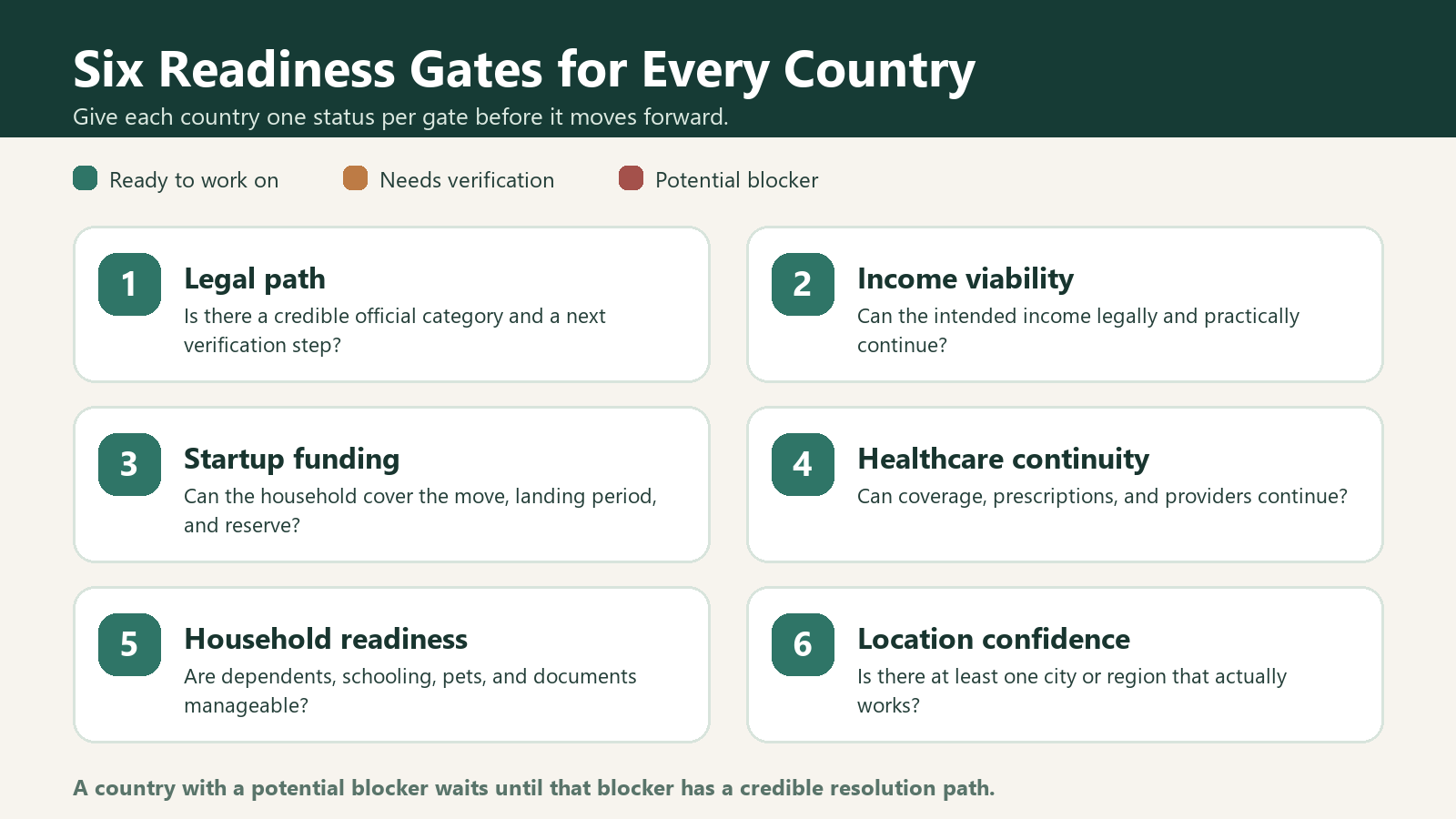
A country with one potential blocker is not automatically eliminated. It should not move forward until the blocker has a credible resolution path.
Step 7: Compare cities, not national averages
The practical relocation unit is usually a city, a region, or a commute area.
Within one country, compare:
- Job access
- Housing availability
- Healthcare distance
- Public transportation and car dependence
- Climate and hazard exposure
- Internet and utilities
- Language environment
- School and childcare options
- Airport access
- Community size and social fit
A country may stay on the shortlist because one region works even when the capital does not. The reverse is also true. The MoveMap article on climate, comfort, and daily life covers the seasonal and routine details that national averages hide.
Step 8: Give every country a tradeoff
A useful comparison should make every option less perfect.
For each country, write:
- Three strongest reasons to keep it
- One major tradeoff
- One condition that would remove it
- One fact that needs an official source
- One experience that needs to be tested in person
If you cannot name the tradeoff, you are probably still comparing marketing images.
Step 9: Remove countries deliberately
A country can leave the shortlist because:
- No credible legal path fits
- The income model fails
- Housing does not support the job or the household
- Healthcare continuity is too uncertain
- The climate conflicts with a hard limit
- Distance is unacceptable
- Language or integration demands are not workable
- The required startup funds exceed the household range
- Another country solves the same problem with fewer risks
Record why it was removed and what evidence would justify reconsidering it. That prevents the same destination from returning every few weeks because of a new video or article.
Step 10: Choose the next evidence step
Do not end with a vague conclusion that one country looks best.
End with one action:
- Ask an employer for written permission
- Confirm a residence category with the official authority
- Price housing in three cities
- Call healthcare providers
- Build a first-year budget
- Begin qualification recognition
- Plan a research trip during a less-comfortable season
- Set up a mail and address plan before the move
The goal is not certainty. The goal is to replace one major assumption with evidence.
A simple way to compare countries for moving abroad
For each country on the shortlist, record:
- Why it is on the list
- Intended legal path
- Intended income
- Strongest city or region
- Estimated startup cost
- Estimated monthly cost
- Healthcare plan
- Biggest household dependency
- Biggest tradeoff
- Potential blocker
- Official source reviewed
- Next action
- Keep, pause, or remove
A notebook page or a spreadsheet tab per country is enough to start. The MoveMap Toolkit is being built to turn this into a full country comparison worksheet alongside the visa, cost, climate, and readiness checklists.
Where official sources belong in the comparison
Every gate above ends with a verification step, and the verification should come from the authority that actually sets the rule rather than from a relocation forum or a video.
Three general starting points apply to most U.S. shortlists:
- Tax questions behind the income gate: the IRS guidance for U.S. citizens and resident aliens abroad
- Health questions behind the healthcare gate: the CDC Travelers Health destination pages
- Coverage continuity for anyone on Medicare: the official Medicare guidance on coverage outside the United States
Immigration questions belong with the destination country authority for that specific category, not with a general travel page. Record the exact page you read and the date you read it, because official requirements change.
The bottom line
A good shortlist is not a ranking of your favorite destinations.
It is a controlled comparison of two to four countries that have a credible legal path, a workable income model, a realistic first-year budget, a healthcare plan, household fit, and at least one plausible location.
Use the same questions for every option. Remove countries when the evidence fails. Keep one wildcard that challenges your assumptions.
Take the MoveMap quiz if you are still deciding what kind of destination may fit your priorities.
Compare the MoveMap country guides when you are ready to research specific options.
Read How to Move Abroad for the full planning sequence around this comparison step, and set up a mail plan once a destination starts to look real.
Join the MoveMap Toolkit waitlist if you want structured worksheets for organizing the comparison.
This article provides educational planning information, not legal, immigration, tax, financial, employment, healthcare, safety, or professional advice. Official requirements and local conditions can change. Verify current information with official sources and qualified professionals before acting.